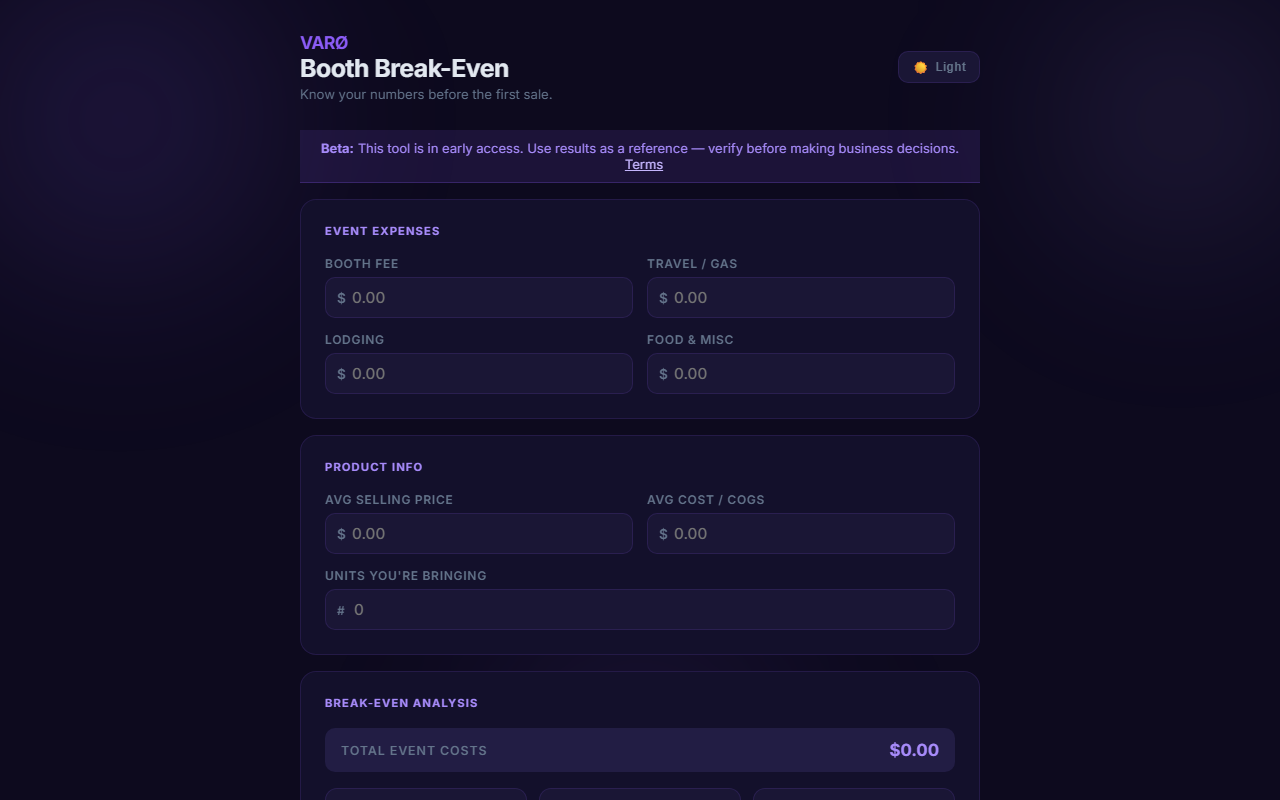
Not every craft fair is worth doing. Some shows have great booth fees but terrible foot traffic. Others charge premium fees but deliver the sales volume to justify it. The question every vendor needs to answer before writing a deposit check: how much do I need to sell just to not lose money?
That's the break-even point. Break-Even.cc calculates it in seconds — enter your booth fee, product costs, and average selling price, and it tells you exactly how many sales you need to cover your costs and start making a profit.
The Break-Even Formula for Craft Vendors
Break-even analysis separates your costs into two types: fixed costs (the booth fee and other event-specific costs that don't change regardless of how much you sell) and variable costs (what each item costs you to produce).
Break-even revenue = Break-even units × Avg. sale price
Example: Booth fee $150. Average sale price $35. Variable cost per unit $8. Contribution margin = $35 − $8 = $27. Break-even = $150 ÷ $27 = 5.6 units — so you need to sell 6 items just to cover your booth fee. Everything after that is profit.
What to Include in Your Fixed Costs
The booth fee is the obvious one, but it's not the only fixed cost for a market day:
- Booth fee / application fee
- Gas or mileage to and from the venue
- Lodging if it's an out-of-town show
- Food for the day (you have to eat)
- Any supplies purchased specifically for this show (new display item, packaging run)
Including all of these gives you the true break-even, not just the number needed to cover the check you wrote to the organizer.
Using Break-Even to Evaluate Shows Before You Apply
Break-even analysis is most powerful before you commit. If you're looking at a show with a $400 booth fee and your average sale is $25 with $7 in variable costs, your break-even is 23 units. Can you realistically sell 23+ items at that show? Look at attendance data, past vendor reports, or similar shows you've done.
This is how you avoid signing up for shows that will lose you money. A low booth fee isn't automatically a good deal — if traffic is terrible, even a $50 booth can be a net loss after your time and gas.
Pairing Break-Even with Event Tracking
If you track your actual sales per event in FairKeep, you build a history of how each show performs relative to your break-even. After a few seasons, you have real data: Show A consistently delivers 3x break-even; Show B barely clears it. That makes your calendar decisions easy.
Free at Break-Even.cc
The break-even calculator at Break-Even.cc is free with no account required. Run the numbers before any show you're considering. It's part of the VendorTools free suite alongside the pricing, tax, and event tracking tools built for craft fair and market vendors.
Frequently Asked Questions
Sources & References
- Break-Even.cc
- FairKeep
- VendorTools
- VendorTools: The Free Toolkit Every Craft Fair Vendor Needs — VARØ Industries Blog
- FairKeep: The Event Tracker Built for Craft Fair Vendors — VARØ Industries Blog
- How to Price Handmade Products: Using MarginD for Craft Vendors — VARØ Industries Blog
- FeeCut: Know Exactly How Much Credit Card Fees Are Eating Into Your Sales — VARØ Industries Blog