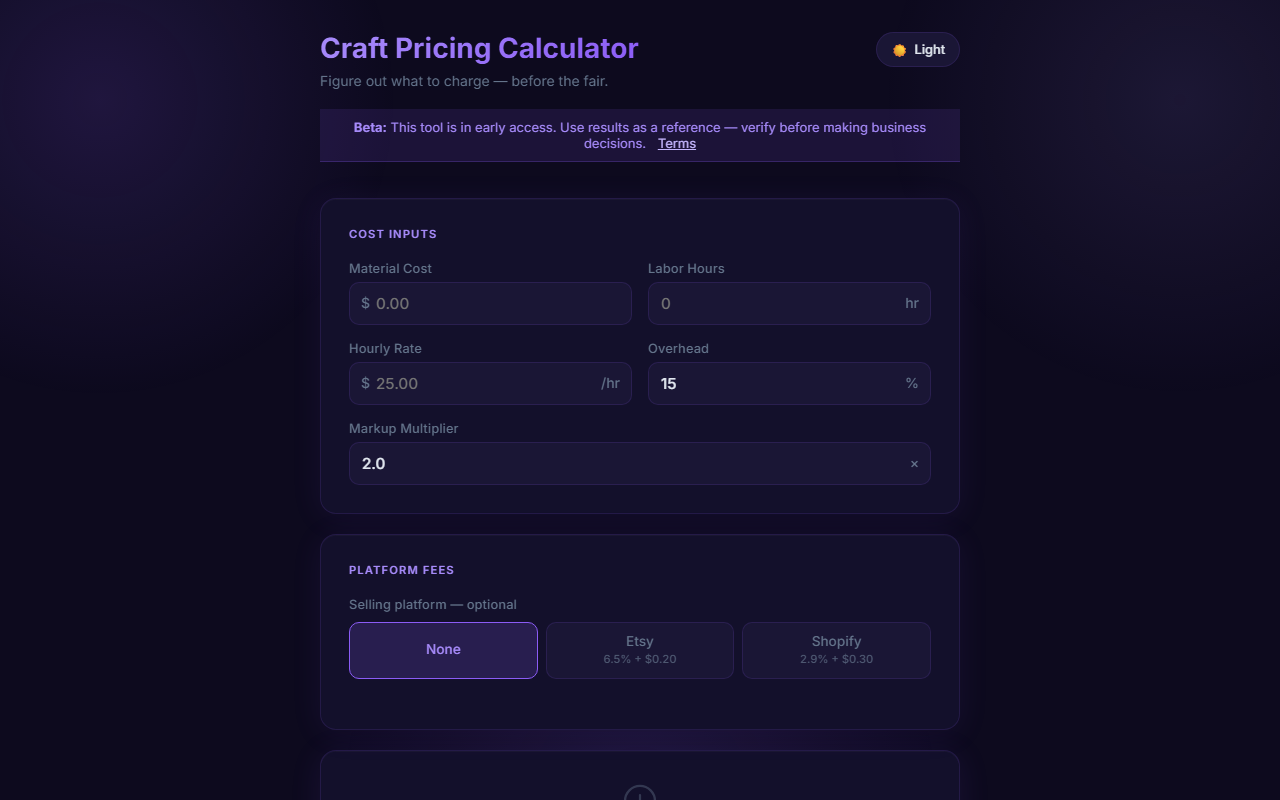
Pricing handmade products is one of the hardest parts of running a craft business. Price too high and you don't sell. Price too low and you're making money but losing it — paying yourself nothing for your time, or worse, actually losing money once you account for all your costs.
The solution is straightforward in principle: know your actual total cost per unit, decide on a target profit margin, and calculate the price from there. MarginD is a free calculator that does exactly this.
Start with Your True Cost Per Unit
Most handmade sellers undercount their costs. They think about materials but forget packaging, or they think about packaging but forget their labor. Every one of these is a real cost that reduces your actual profit:
- Materials — everything consumed to make one unit
- Labor — your time at a rate you'd accept (don't price labor at $0)
- Packaging — boxes, bags, tissue paper, labels, thank-you cards
- Overhead allocation — booth fees, craft fair supplies, equipment amortized over units
Add all of these up and you have your true cost per unit. This is your floor — you can't price below this number without losing money, regardless of what the market will bear.
Markup vs. Margin: Know the Difference
These two terms get confused constantly. They're related but different:
Margin: Price = Cost ÷ (1 − margin %)
A 50% markup on a $10 cost = $15 price, with a 33.3% margin. A 50% margin on a $10 cost = $20 price, with — obviously — a 50% margin. MarginD lets you work in either direction and shows both numbers so you know exactly what you're looking at.
What Margin Should Craft Vendors Target?
There's no universal answer, but craft fair vendors selling handmade products typically need 40–60% gross margins to have a viable business after accounting for market days that underperform. Lower-margin products only work if your volume is very high — hard at a two-day craft fair.
Higher-margin products give you room to discount for end-of-show sales without going underwater. They also let you absorb a slow market without losing money overall. See also: break-even calculator for booth fees.
Reality-Check Your Price Against the Market
Once MarginD gives you the math-correct price, you need to sanity-check it against what comparable products actually sell for. If your cost-plus price for a candle is $45 and everyone else at the market sells candles for $18, you have a cost problem, not a pricing problem — the cost structure needs to change, not the margin target.
Free at MarginD.app
MarginD is free with no account required. Enter your costs, choose your margin or markup target, and get the retail price instantly. It's part of the VendorTools suite of free tools for craft fair and market vendors.
Frequently Asked Questions
Sources & References
- MarginD
- VendorTools
- VendorTools: The Free Toolkit Every Craft Fair Vendor Needs — VARØ Industries Blog
- FairKeep: The Event Tracker Built for Craft Fair Vendors — VARØ Industries Blog
- Break-Even Calculator for Craft Fair Booth Fees: Is This Market Worth It? — VARØ Industries Blog
- FeeCut: Know Exactly How Much Credit Card Fees Are Eating Into Your Sales — VARØ Industries Blog