Craft fair vendors often price their products in round numbers — $20, $35, $50 — because it makes cash transactions easy and your price tags simple. But if you're required to collect sales tax in your state, that means the tax is baked into the price. At the end of the day, you need to know: how much of what you collected was actually tax?
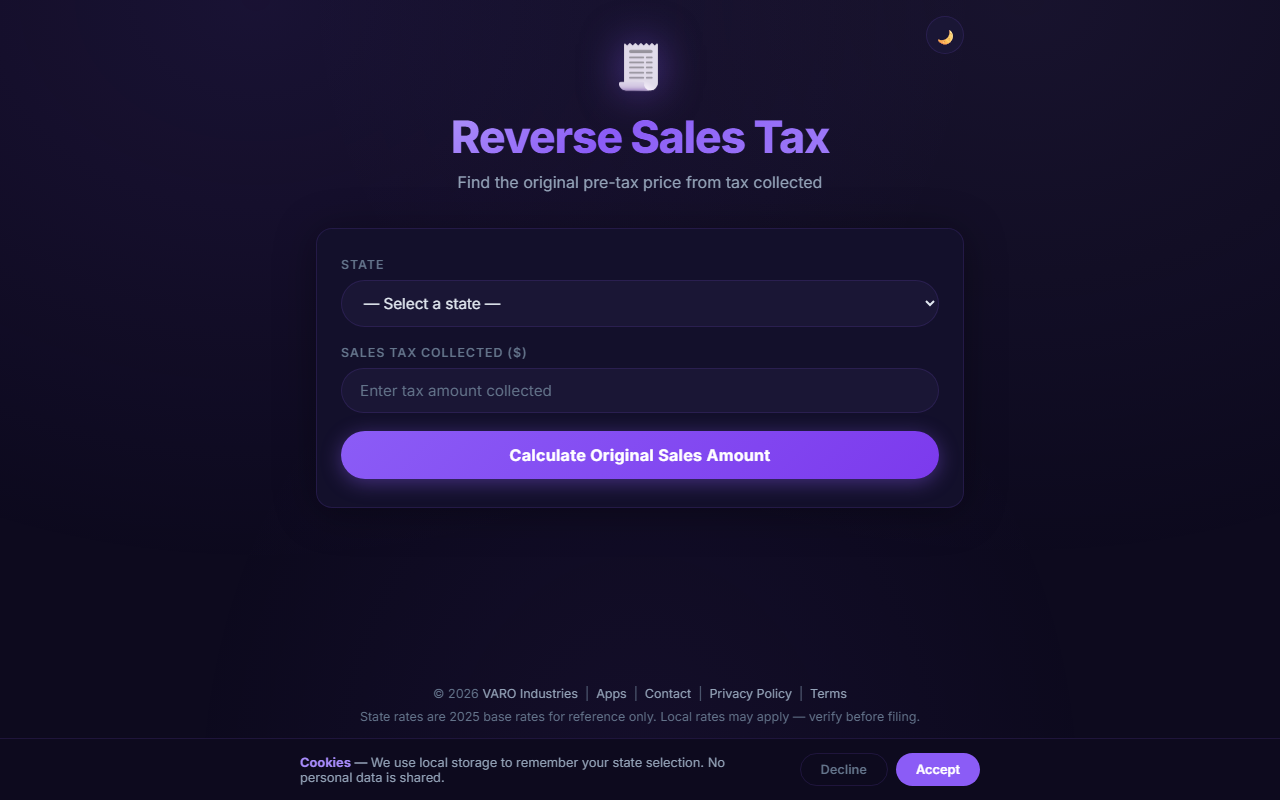
That's reverse sales tax. You start with the total you charged the customer and work backwards to the pre-tax amount and the exact tax collected. ReverseSalesTax.us does this calculation instantly for free.
The Reverse Sales Tax Formula
The math is straightforward once you see it. If a total price already includes tax, you divide it by (1 + the tax rate as a decimal):
Tax collected = Total − Pre-tax price
Example: You sold a cutting board for $54.00 in a state with a 6% sales tax rate. Pre-tax price = $54.00 ÷ 1.06 = $50.94. Tax collected = $54.00 − $50.94 = $3.06.
If you're filing quarterly, you add up all the tax collected across your sales and remit that amount to your state. The reverse calculation is how you get from your gross receipts to the number the state actually wants.
Why This Matters for Craft Fair Vendors
At a craft fair, you're unlikely to add a separate tax line to each transaction. You post your prices, customers hand you cash or tap their card, and you move on to the next person. The tax is included — but it still has to be accounted for and remitted.
At the end of a market day, you have a total sales number. The reverse calculation splits that into pre-tax revenue (what you actually earned) and tax collected (what you owe the state). Getting this wrong — either under-remitting or over-keeping — creates problems at filing time.
Free Calculator at ReverseSalesTax.us
Rather than doing this math by hand for every transaction, ReverseSalesTax.us handles it in seconds. Enter your total amount charged and your state's tax rate, and the calculator returns the pre-tax price and exact tax collected. No account needed.
It works for any US state rate or combined state-and-local rate. If your city has an additional local sales tax on top of the state rate, enter the combined rate and the calculation is still accurate.
Combine with the Sales Tax Owed Calculator
If you want to know the total tax you owe after a full season of markets, see the sales tax owed calculator — enter your total sales and state rate to get the filing amount. Both tools are part of the VendorTools free suite for craft fair and market vendors.
A Note on Tax Compliance
This calculator gives you the math. For guidance on whether you're required to collect sales tax in a given state, what exemptions apply, or how to register as a vendor, consult your state's revenue department or a tax professional. Sales tax rules vary by state and product type — handmade goods are sometimes exempt, sometimes not.
Frequently Asked Questions
Sources & References
- ReverseSalesTax.us
- VendorTools
- VendorTools: The Free Toolkit Every Craft Fair Vendor Needs — VARØ Industries Blog
- FairKeep: The Event Tracker Built for Craft Fair Vendors — VARØ Industries Blog
- How Much Sales Tax Do You Owe? A Guide for Craft Fair Vendors — VARØ Industries Blog
- FeeCut: Know Exactly How Much Credit Card Fees Are Eating Into Your Sales — VARØ Industries Blog
- MakeChange: Never Count Back Change Wrong at a Craft Fair Again — VARØ Industries Blog