I make switch plates for a living, and the most common question I get isn't about wood. It's "which one do I need?" Most wrong orders come from the same few mix-ups, and most of them happen because people shop for the plate instead of looking at what's in the wall.
So that's where this starts. Figure out the device, count the gangs, read the layout left to right, pick a size, and check the list of mix-ups before you buy. It takes about five minutes and a tape measure.
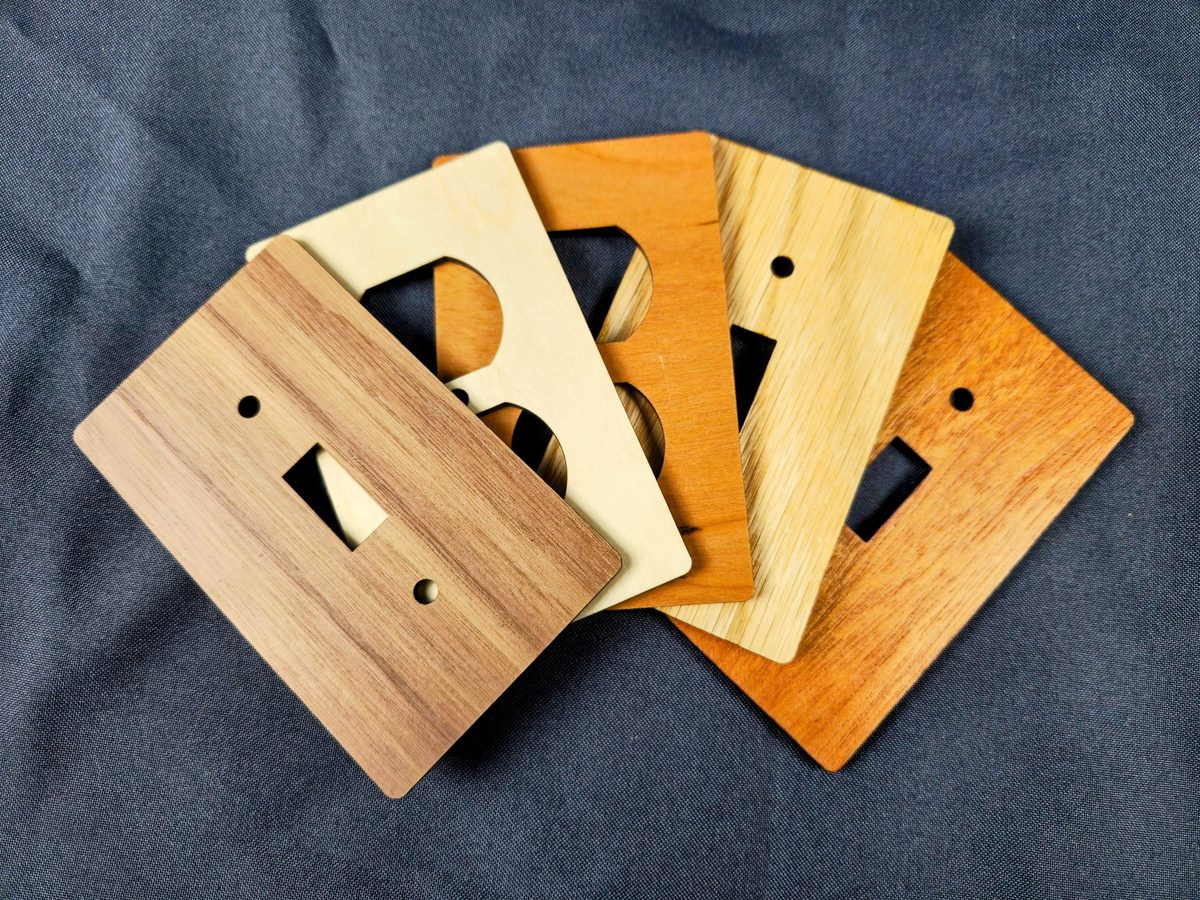
Start With What's in Your Wall
The plate is just a cover. What decides the plate is the device behind it: the switch, outlet, dimmer or jack. Look at the shape of the part that sticks through the plate, not at what the device does. A dimmer, a timer and a USB charger can all take the same plate.
Toggle
The classic flip lever. The plate has a small rectangular slot, about 0.41" x 0.94", with a screw above and a screw below it, 2-3/8" apart.
Decora (also called rocker or decorator)
A large rectangular opening, 1-5/16" x 2-5/8", with screws 3-13/16" apart. This one opening covers a lot of devices: GFCI and AFCI outlets, USB-A/USB-C outlets with a rectangular face, smart switches (Lutron Caseta, Leviton, Kasa), rocker switches, and flat slide dimmers. If the face of your device is a rectangle, it's almost certainly Decora. (A regular toggle lever with a small slider beside it is still a toggle. Go by the shape.)
Duplex outlet
The standard household outlet: two rounded plug openings stacked vertically, held by one screw in the center between them.
The rest, in one line each
- Rotary dimmer: a round knob on a shaft. The plate has a small round hole: pull the knob off, put the plate on, and push the knob back on over it.
- Blank: no opening at all, for a box with nothing in it.
- Coax, phone and data: a round hole for one cable TV connector, or keystone openings for snap-in jacks (more on that below).
- Old-house types: Despard (small stacked devices on a strap), push-button switches (two buttons, one above the other) and low-voltage switches each take their own plate.
Every opening above, with sizes, is in the switch plate reference.
Count the Gangs
A gang is one device position, side by side. A plate with one switch is 1-gang. Three switches in a row is 3-gang. Gangs only count across, never up and down: a duplex outlet has two plugs but it's one device in one position, so it's 1-gang.
The fastest way to count is from the openings and screws:
- Toggles and Decoras: one opening per gang, with a screw above and below each one.
- Duplex outlets: one pair of plug openings and one center screw per gang. Two duplexes side by side (four plugs) is a 2-gang plate.
- Count the columns, not the holes.
Combination Plates: Read Left to Right
When gangs don't match (a switch next to an outlet, a toggle next to a rocker), you need a combination plate, and order matters. Read the layout left to right as you face the wall. A toggle + Decora plate has the toggle on the left. A Decora + toggle plate has it on the right. They're listed and sold as two different plates.
Write it down the way you'd read it: "2-gang: toggle, Decora." Or "3-gang: Decora, Decora, duplex." That one line is everything a maker needs to cut the right plate.
Sizes: Standard, Midway and Jumbo
Standard plates are 4-1/2" tall. The width grows with each gang:
| Gangs | Standard width |
|---|---|
| 1-gang | 2-3/4" (2.75") |
| 2-gang | 4-9/16" (4.5625") |
| 3-gang | 6-3/8" (6.375") |
| 4-gang | 8-3/16" (8.1875") |
Midway (sometimes sold as "oversized") plates are a step larger on every side. Midway sizes vary by brand, so measure rather than trust the label. Jumbo is the next step up; a 1-gang jumbo is 3-1/2" x 5-1/2".
Size up when the old plate is hiding something:
- Paint lines. Someone painted around the old plate, and a standard plate shows the outline.
- Drywall damage. Torn paper, chips or a patch around the box.
- An oversized box cut-out. The hole in the drywall is bigger than the plate.
Take the old plate off before you order and look. A lot of the custom sizes I cut are exactly this: a plate just big enough to cover a bad cut-out.
Common Mix-Ups
These are the mistakes I see most, including in the big-store buying guides.
Duplex vs. Decora
A GFCI is not a duplex outlet. It has two plug faces, but they sit on one rectangular face with TEST and RESET buttons, and that takes a Decora plate. The same goes for most USB outlets and every rocker-style device. "Duplex" means the two-opening, center-screw plate and nothing else. And a 2-gang rocker plate is a 2-gang rocker plate, even if one of the devices behind it is a nightlight.
Proprietary and screwless systems
If you see no screws on the plate, look closer before you order. There are two different things going on:
- Legrand adorne is its own system. Legrand designs adorne plates to fit adorne devices only. The plate snaps into a metal sub-frame, and the devices come in their own sizes, including half-size modules. Standard plates don't fit adorne devices, and adorne plates don't fit standard ones.
- Screwless decorator plates, like Legrand radiant screwless or Lutron Claro, snap onto a plastic sub-plate or adapter frame that's screwed to an ordinary Decora device. Pop the cover off, unscrew the sub-plate, and a standard Decora plate fits. What you can't do is snap a standard plate onto that sub-plate, or mix one brand's cover with another brand's sub-plate.
How to spot them: no visible screws, a plate that pries off instead of unscrewing, and a frame or sub-plate underneath it. If you find a metal frame with odd-sized devices, it's probably adorne.
Toggle vs. Despard in older homes
In older houses, a small switch can look like a toggle and isn't. Despard devices are small switches, outlets and pilot lights that clip into a metal strap, up to three in one gang. The plate has one to three small openings stacked in the gang, wider and shorter than a toggle slot, and its screws are 3-13/16" apart. A toggle plate has one slot and screws 2-3/8" apart. If you have three little switches in a single-width plate, that's Despard.
Coax vs. keystone vs. brush plates
- Coax plate: one round hole for a threaded cable TV connector.
- Keystone plate: rectangular openings that take snap-in jacks (Ethernet, coax, HDMI and others), so one plate can mix connection types. If your coax connector is mounted in a small rectangular insert, that's a keystone plate, not a coax plate.
- Brush or pass-through plate: a slot lined with bristles. Cables run straight through it, usually behind a wall-mounted TV. Nothing connects to the plate itself.
A box that isn't flush with the wall
A plate that rocks, gaps or won't pull tight is a depth problem, and a deeper plate isn't the fix.
- Device sits out past the wall: a backing plate fills the gap so the cover sits flat. Mine are 1/8" and can be stacked. Thicker stacks may need longer screws.
- Device sits behind the wall surface (a recessed box): fix it behind the plate. Spacers under the device's mounting ears, or a box extender, bring it forward. Turn the power off first, and call an electrician if you're not sure.
Measure Before You Buy
- Count the gangs. Columns, not holes.
- Identify each opening, left to right. Toggle, Decora, duplex, blank and so on. Write it down in order.
- Measure the old plate, width x height. Compare it with the standard sizes above. If it's bigger, you need a midway, jumbo or custom size to cover the same wall.
- Check the surroundings. Note anything close to the plate: door trim, a cabinet, tile or a backsplash edge. A plate that has to fit a tight spot may need to be trimmed or narrower.
If you want to be sure before you buy, print my cardboard test templates for a toggle, Decora and duplex outlet. Print at 100% ("Actual size"), cut one out and hold it on the wall. And if you're still unsure, send me a photo of the plate on the wall ([email protected] or the contact form) and I'll tell you what you need. I'd much rather answer a question than have you order the wrong thing.
Materials at a Glance
- Plastic: the default. Inexpensive and widely available. Some plastics flex; harder ones can crack if the screw is overtightened.
- Metal: stainless steel, brass and other finishes. Durable and easy to wipe clean.
- Wood: warmer and more decorative. Mine are real wood veneer on both faces of a stable MDF core. Like any wood, the grain and color vary from plate to plate.
- Acrylic: laser-cut plastic sheet in solid colors, mirror finishes and patterns. Good when you want the plate to stand out.
Quick Reference: Device to Plate
| What's in the wall | Plate opening | Buy this plate |
|---|---|---|
| Flip lever switch | Small slot | Toggle |
| Rocker or paddle switch | Large rectangle | Decora |
| GFCI or AFCI outlet | Large rectangle | Decora (not duplex) |
| USB outlet, rectangular face | Large rectangle | Decora |
| Smart switch or dimmer (Caseta, Leviton, Kasa) | Large rectangle | Decora |
| Flat slide dimmer | Large rectangle | Decora |
| Standard two-plug outlet | Two rounded openings | Duplex |
| Rotary dimmer (knob) | Small round hole | Rotary dimmer |
| Empty box | None | Blank |
| Cable TV connector | Round hole | Coax, or keystone with a coax insert |
| Ethernet, phone, HDMI jacks | Snap-in openings | Keystone |
| Cables passing through | Bristle slot | Brush / pass-through |
| Up to 3 small stacked devices | Small stacked openings | Despard |
| Two push buttons | Two round buttons | Push-button |
| Legrand adorne device | adorne | adorne plate only |
| Two or more different devices | Mixed | Combination, named left to right |
If You Want Wood
I make wood switch plates in 17 woods, in every standard layout above plus combinations and custom sizes, cut to order in North Attleboro, Massachusetts. You'll find them in my Etsy shop, and the full reference (every opening, size, screw spacing and wood) is on the switch plates page. If your layout isn't listed, send me the left-to-right description and a photo, and I'll quote it before I cut anything.
Frequently Asked Questions
Sources & References
- adorne Wall Plates — Legrand (adorne plates are designed to fit adorne devices only)
- adorne Sub Frame — Legrand (the metal mounting frame adorne plates snap into)
- radiant Screwless Wall Plates — Legrand (sub-plate mounting; fits standard decorator devices)
- Wallplates and Accessories — Lutron (Claro designer plates)
- Despard Mounting Strap — Legrand / Pass & Seymour (Despard straps and 3-13/16" plate screw spacing)
- Switch Plate Reference: Openings, Sizes, Screws and Woods — VARØ Industries
- Printable Cardboard Test Templates (Toggle, Decora, Duplex) — VARØ Industries
- How to Attach a Backing Plate — VARØ Industries Blog
- 1/2" or 3/4"? Screw Lengths for Switch and Outlet Plates — VARØ Industries Blog
- How to Measure Switch Plate Screw Holes for a Custom-Fit Cover — VARØ Industries Blog